
FRACS at the Service of the Airport Ecosystem
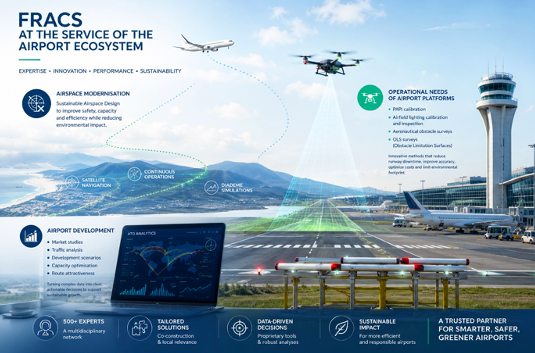
In a constantly evolving aviation sector, airports must simultaneously address challenges related to connectivity, capacity, operational performance, regulatory compliance, and environmental transition. These challenges cannot be dealt with separately: they require a comprehensive understanding of the airport ecosystem, its local constraints, and its development ambitions. It is precisely within this integrated approach that France Aviation Civile Services (FRACS) operates.
FRACS supports airport operators in designing solutions tailored to each specific context. Rather than applying standardised models, the company favours a bespoke approach based on analysis, co-construction, and the mobilisation of relevant expertise. With a network of more than 500 experts from civil aviation, regulation, operations, engineering, airlines, and the airport sector, FRACS operates at the crossroads of strategic, technical, and operational challenges.
This support capability is first reflected in the modernisation of airspace. Through Sustainable Airspace Design, the objective is to reconcile flight safety, traffic fluidity, capacity, and the reduction of environmental impact. Drawing on proven methodologies, satellite-based navigation, continuous descent and climb operations, and simulation tools such as DIADEME, FRACS designs and tests scenarios aimed at improving flight paths, reducing unnecessary fuel consumption, and supporting traffic growth in a responsible manner.
FRACS’ expertise also extends to the operational needs of airport platforms. Through drone technologies, FRACS performs PAPI calibration, calibration and inspection of airfield lighting systems, as well as aeronautical obstacle surveys and OLS surveys (Obstacle Limitation Surfaces). These innovative methods help reduce runway downtime, improve measurement accuracy, optimise costs, and contribute to reducing the environmental footprint of operations.
Finally, FRACS provides solutions in airport development. Market studies, traffic analysis, development scenarios, capacity optimisation, and route attractiveness: FRACS helps decision-makers transform complex data into clear, realistic, and actionable guidance. Its proprietary tools, including its air traffic databases and the ATD Analytics platform, make it possible to support analyses with objective data and anticipate future needs.
From strategic consulting to field innovation, FRACS positions itself as a trusted partner to support airports in their transformation, with one shared requirement: to build useful, sustainable solutions adapted to the realities of each platform.

